How do you calculate UPS capacity?
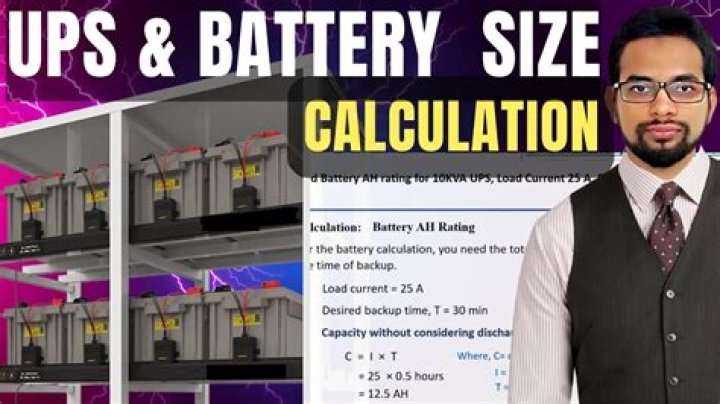
- calculate battery power of the UPS (ie battery voltage) * AH.
- time = (inverter efficiency * battery volt * AH)/load in watts)
.
Also know, how is battery backup calculation?
For example, say you want to run a 250 watt 110VAC light bulb from an inverter for 5 hours. Amp-hours (at 12 volts) = watt-hours / 12 volts = 1470 / 12 = 122.5 amp-hours. If you are using a different voltage battery the amp-hours will change by dividing it by the battery voltage you are using.
Similarly, how many watts is 100 amps? In other words, a 100-amp electrical service should be expected to provide no more than 19,200 watts of power load at any given time.
Also to know, how long will a 1500va ups run?
A UPS with a 1500VA rating can keep a computer running for less than an hour. You're lucky if you get more than 10 minutes of run time when running a PC, a networking gear, and a monitor. So generally, you can use your UPS as a backup power supply for not very long.
How many amps are in a Volt?
Volts / Watts / Amps Converter Watts is also known as volt-amps and is typically used in conjunction with AC power circuits. Fill in any of the two fields to find the value of the third. You have a 12 Volt power supply that delivers 1 Amp of current.
Related Question AnswersHow do I calculate amps?
The formula for Amps is Watts divided by Volts. To use the chart, cover up the A with your finger and use the remaining chart calculation of W divided by V. Using our sample panel data, 60 watts divided by 12 volts equals 5 amps.How do I figure out how many amps I need?
How to Calculate Amperage Needed- Determine the number of volts and watts required by each device to be added to the circuit.
- Divide the number of watts required by the volts to determine the needed amperage.
- Add the total number of amps required by each device together to determine the amperage needed to safely operate all devices on the same circuit.
How can calculate percentage?
1. How to calculate percentage of a number. Use the percentage formula: P% * X = Y- Convert the problem to an equation using the percentage formula: P% * X = Y.
- P is 10%, X is 150, so the equation is 10% * 150 = Y.
- Convert 10% to a decimal by removing the percent sign and dividing by 100: 10/100 = 0.10.
How many watts are in a ampere?
Equivalent Watts and Amps at 12V DC| Power | Current | Voltage |
|---|---|---|
| 120 Watts | 10 Amps | 12 Volts |
| 130 Watts | 10.833 Amps | 12 Volts |
| 140 Watts | 11.667 Amps | 12 Volts |
| 150 Watts | 12.5 Amps | 12 Volts |
What is the formula for calculating electrical load?
Use the Ohm's law formula: Power (watts) = Voltage (volts) x I current (amps). Arrange the equation for three-phase power to solve the current (amps): Current (amps) = power (watts) ÷ voltage (volts) ÷ square root of 3 (1.732) ÷ power factor; I = P ÷ (V_1.732_p.f.).How much kVA is required for a house?
During normal energy use, the power supplied by your meter (9.2 kVA on average) should suffice. In theory, this allows you to simultaneously supply devices with a maximum power of 9.2 kW or 9200 watts.How long will a 12v 100ah battery last?
1000 hoursHow many watts is a 150ah battery?
150AH battery mean it can provide 150A for one hours and after that it got discharged. for 12v battery 100% is 13v, and 0% is 10.5v, so average 12v we took, means battery can deliver 1.8 unit power if full charged.How many hours does a 150ah battery last?
If the battery is a lead acid and is labeled as a 150Ah battery that means that it should discharge at or provide 7.5 amps over a 20 hour time period. Because that's the industry standard for measuring Amp Hours in a lead acid battery.How many Ah battery do I need for home?
Consider that you need a battery that provides back up for 3 hours. Therefore a battery with a capacity of 130 Ah will work for you. So if you want to run 3 fans, 3 tube lights , 1 CFL and 1 TV for 3 hours during power failure you would need 800VA inverter and 130 Ah battery.How many hours does a 200ah battery last?
20 HoursHow do you measure battery size?
How to Size a Battery Bank - Part 2- [(AC Average Load/ Inverter Efficiency) + DC Average Load] / System Voltage = Average Daily Ampere-hours.
- Average Daily Ampere-hours x Days of Autonomy = Total Ampere-hours.
- Total Ampere-hours / (Discharge Limit x Selected Battery Capacity) = Batteries in parallel.