What body system does the ear belong to?
.
Furthermore, what body system are the ears in?
-Peripheral nervous system consists of the sense organs (eyes, ears, taste buds, olfactory receptors, touch receptors) and the nerves which connect the spinal cord with the rest of the body.
Likewise, which body system does the bladder belong to? Urinary System
In respect to this, what system are the eye and ear part of?
The Cranial Nervous System nerves connect the brain to the eyes, mouth, ears and other parts of the head.
What are the parts of the ears and their functions?
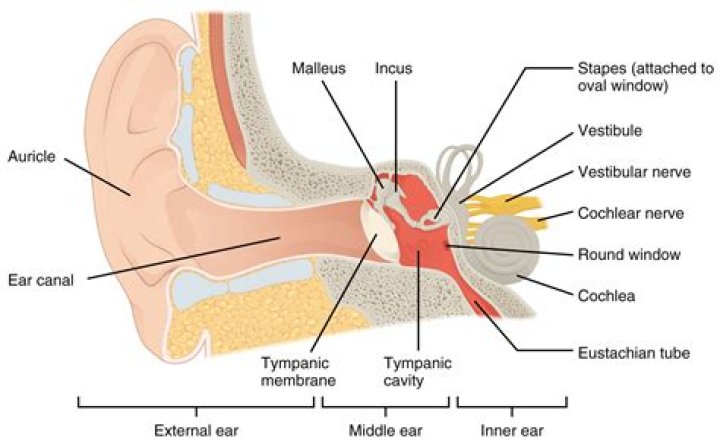
The ear's function is to transmit and transduce sound to the brain through the parts of the ear: the outer ear, the middle ear and the inner ear. The major task of the ear is to detect, transmit and transduce sound. Another very important function of the ear is to maintain our sense of balance.
Related Question AnswersAre ears an organ?
The ear is the organ of hearing and, in mammals, balance. In mammals, the ear is usually described as having three parts—the outer ear, the middle ear and the inner ear. The outer ear consists of the pinna and the ear canal.How many bones are in your ear?
threeWhat is the main function of ear?
The ears are organs that provide two main functions — hearing and balance — that depend on specialized receptors called hair cells.Is the eye considered an organ?
The human eye is an organ that reacts to light and allows vision. Rod and cone cells in the retina allow conscious light perception and vision including color differentiation and the perception of depth. The eye is part of the sensory nervous system.Are the ears connected?
A canal that links the middle ear with the back of the nose. The eustachian tube helps to equalize the pressure in the middle ear. Having the same pressure allows for the proper transfer of sound waves. The eustachian tube is lined with mucous, just like the inside of the nose and throat.Where is inner ear located?
The inner ear is located within the petrous part of the temporal bone. It lies between the middle ear and the internal acoustic meatus, which lie laterally and medially respectively. The inner ear has two main components – the bony labyrinth and membranous labyrinth.How big should your ears be?
Typically, men's ears are larger than women's, according to a study in the journal Plastic and Reconstructive Surgery. Researchers also found that the average ear is about 2.5 inches (6.3 centimeters) long, and the average ear lobe is 0.74 inches (1.88 cm) long and 0.77 inches (1.96 cm) wide.Where is your eardrum located?
The outer ear includes: auricle (cartilage covered by skin placed on opposite sides of the head) auditory canal (also called the ear canal) eardrum outer layer (also called the tympanic membrane)Which part of the brain controls balance?
cerebellumAre eyes and ears connected?
The inner ear and the muscles that move your eyes are intimately connected through a reflex called the vestibulo-ocular reflex or VOR. For some people who have very poor inner ear function in both ears, they just cannot see clearly whenever they are in motion.Where is the central nervous system located in the body?
The central nervous system (CNS) includes the nerves in the brain and spinal cord. It is safely contained within the skull and vertebral canal of the spine. All of the other nerves in the body are part of the peripheral nervous system (PNS).How does ear help in balancing?
The semicircular canals of the inner ear help you with balance. This movement of the fluid moves the hairs of the canals, creating nerve impulses that travel up to your brain and let it know that your head is off balance. You don't fall over because your brain tells your muscles to support you.How long is human nervous system?
The spinal cord is a long bundle of nerve tissue about 18 inches long and 1/2-inch thick. It extends from the lower part of the brain down through spine. Along the way, nerves branch out to the entire body.How does ear balance work?
The vestibular system (inner ear balance mechanism) works with the visual system (eyes and the muscles and parts of the brain that work together to let us 'see') to stop objects blurring when the head moves. It also helps us maintain awareness of positioning when, for example, walking, running or riding in a vehicle.Are the eyes part of the brain?
The eye is the only part of the brain that can be seen directly – this happens when the optician uses an ophthalmoscope and shines a bright light into your eye as part of an eye examination. And if pressure in the brain increases, perhaps due to a brain tumour, we can see this as a swelling of the optic nerve.How do humans balance?
The vestibular system, the region of the inner ear where three semicircular canals converge, works with the visual system to keep objects in focus when the head is moving. The balance system works with the visual and skeletal systems (the muscles and joints and their sensors) to maintain orientation or balance.Why is vision important for balance?
While vision may not appear to be the most important factor in keeping balance, the body needs them to maintain it normally. It takes the vestibular, vision, and proprioceptive systems working together to keep things level; but it is the vision which provides most of the necessary information.How do all the body systems work together?
All of your body systems have to work together to keep you healthy. Your bones and muscles work together to support and move your body. Your respiratory system takes in oxygen from the air. Your circulatory system carries oxygen, water, and nutrients to cells throughout your body.Is the Rectum an organ?
Major Organ Systems| System | Organs in the System | Some Major Functions of the System |
|---|---|---|
| Digestive | Mouth Esophagus Stomach Small intestine Large intestine Rectum Anus Liver Gallbladder Pancreas (the part that produces enzymes) Appendix | Extracts nutrients from foods Excretes waste products from the body |


