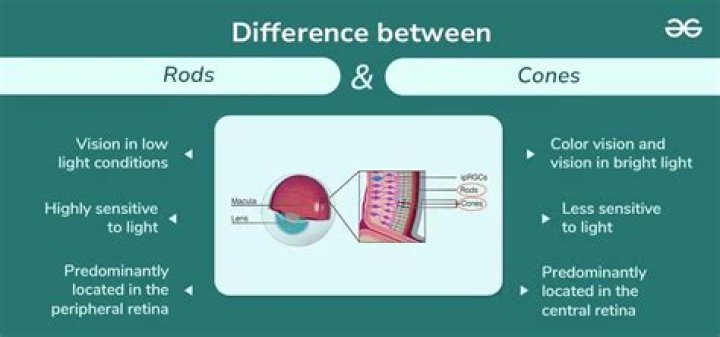
Rods are ultra-sensitive to light and simply detect light, good for night vision. No color vision. Cones are responsible for color vision..
In this regard, what different types of vision do rods and cones provide?
Rods are responsible for vision at low light levels (scotopic vision). They do not mediate color vision, and have a low spatial acuity. Cones are active at higher light levels (photopic vision), are capable of color vision and are responsible for high spatial acuity. The central fovea is populated exclusively by cones.
Also Know, how many rods does each eye contain quizlet? More rods than cones in retina- about 100 million rod cells. Each rod cell contains about 100 million rhodopsin molecules. cone-shaped, mostly located at fovea, respond to higher intensity light. Three types of cone cells that respond to different ranges of light wavelengths.
Just so, how do rods differ from cones in the retina quizlet?
Describe and explain the differences between rod and cone cells in their sensitivity and acuity. Cones respond to colour, rods respond black and white. Cones require a higher light intensity to respond. Cones have greater acuity and rods have lower acuity.
How many rods and cones are in the human eye?
The human retina contains about 120 million rod cells, and 6 million cone cells. The number and ratio of rods to cones varies among species, dependent on whether an animal is primarily diurnal or nocturnal.
Related Question Answers
What are the 3 types of cones in the eye?
In 1965 came experimental confirmation of a long expected result - there are three types of color-sensitive cones in the retina of the human eye, corresponding roughly to red, green, and blue sensitive detectors.What are cones responsible for?
Cone cells, or cones, are photoreceptor cells in the retinas of vertebrate eyes (e.g. the human eye). They respond differently to light of different wavelengths, and are thus responsible for color vision and function best in relatively bright light, as opposed to rod cells, which work better in dim light.How many color rods do humans have?
There are about 120 million rods in the human retina. The cones are not as sensitive to light as the rods. However, cones are most sensitive to one of three different colors (green, red or blue). Signals from the cones are sent to the brain which then translates these messages into the perception of color.What are rods in eyes?
Rod cells are photoreceptor cells in the retina of the eye that can function in less intense light than the other type of visual photoreceptor, cone cells. Rods are usually found concentrated at the outer edges of the retina and are used in peripheral vision.What colors do Cones see?
Cones require a lot more light and they are used to see color. We have three types of cones: blue, green, and red. The human eye only has about 6 million cones.What color do humans see best?
The green color was created by analyzing the way the rods and cones in our eyes are stimulated by different wavelengths of light. The company found that the human eye is most sensitive to light at a wavelength of 555 nanometers—a bright green.What are cones and rods in eyes?
Rods and Cones are the photoreceptors found in the eye, rods have rod-like structure and provide twilight vision, while cones are of the cone shape, fewer in number and provides the vision in the day or bright light. Rods are found around the boundary of the retina, whereas cones are there in the centre of the retina.What are the functions of rod and cone cells?
Rods are responsible for vision at low light levels (scotopic vision). They do not mediate color vision, and have a low spatial acuity. Cones are active at higher light levels (photopic vision), are capable of color vision and are responsible for high spatial acuity. The central fovea is populated exclusively by cones.Where are rods and cones located?
The rods and cones are the photoreceptive cells of the retina, at the rear of the eye. The cones cells are responsible for color vision, and are most dense in the central portion of the retina, an area called the fovea.What is the Fovea Centralis and why is it important?
It is located in the center of the macula lutea of the retina. The fovea is responsible for sharp central vision (also called foveal vision), which is necessary in humans for activities for which visual detail is of primary importance, such as reading and driving.How do rods and cones differ functionally quizlet?
How do rods and cones differ functionally? Rods work in dim light; provide indistinct, fuzzy, non-color peripheral vision. Cones work in bright light; provide high-acuity color vision. Anything that must be viewed is focused on the fovea because it's the area of greatest visual activity.What is the function of rod cells quizlet?
What is the difference in function between the rod cells and cone cells? Rods are ultra-sensitive to light and simply detect light, good for night vision. No color vision. Cones are responsible for color vision.What is meant by the term photochemical pigment?
Photopigment. From Wikipedia, the free encyclopedia. Photopigments are unstable pigments that undergo a chemical change when they absorb light. The term is generally applied to the non-protein chromophore moiety of photosensitive chromoproteins, such as the pigments involved in photosynthesis and photoreception.What is the fovea of the eye?
Fovea: In the eye, a tiny pit located in the macula of the retina that provides the clearest vision of all. Only in the fovea are the layers of the retina spread aside to let light fall directly on the cones, the cells that give the sharpest image. Also called the central fovea or fovea centralis.Where do the nerve fibers from the rods and cones come together quizlet?
a short distance from the fovea there is a small region of the retina where there are no rods and no cones-no photoreceptors at all. This is the place where the axons from the neurons in the retina come together in a bundle called the optic nerve and exit the eyeball on the way to the brain.Which type of photoreceptors allows us to see color?
We have two main types of photoreceptors called rods and cones. They are called rods and cones because of their shapes. These cells are located in a layer at the back of the eye called the retina. Rods are used to see in very dim light and only show the world to us in black and white.What are rods quizlet?
Rods: sensitivity to light. these cells are more sensitive to light and function well in dim light. cones: sensitivity to light. these cells are less sensitive to light and function well in bright light. You just studied 6 terms!What is another term for Palpebrae?
Palpebrae. Another name for Eyelids. Medial Canthus. The medial meeting location of the upper and lower palpebrae.What is the main function of rods in the eye quizlet?
A) Rods absorb light throughout the visual spectrum but confer only gray tone vision.