What happens to a confidence interval if you increase the confidence level?
.
Likewise, people ask, what happens to the confidence interval when the confidence level increases?
Increasing the confidence will increase the margin of error resulting in a wider interval. Increasing the confidence will decrease the margin of error resulting in a narrower interval.
Furthermore, what affects the confidence interval? Factors affecting the width of the confidence interval include the size of the sample, the confidence level, and the variability in the sample. A larger sample will tend to produce a better estimate of the population parameter, when all other factors are equal.
Also, what is the relationship between the confidence level and the size of the confidence interval?
The larger your sample, the more sure you can be that their answers truly reflect the population. This indicates that for a given confidence level, the larger your sample size, the smaller your confidence interval.
How do you increase confidence intervals?
- Increase the sample size. Often, the most practical way to decrease the margin of error is to increase the sample size.
- Reduce variability. The less that your data varies, the more precisely you can estimate a population parameter.
- Use a one-sided confidence interval.
- Lower the confidence level.
What is a high confidence interval?
Apparently a narrow confidence interval implies that there is a smaller chance of obtaining an observation within that interval, therefore, our accuracy is higher. Also a 95% confidence interval is narrower than a 99% confidence interval which is wider. The 99% confidence interval is more accurate than the 95%.How do you know if a confidence interval is significant?
So, if your significance level is 0.05, the corresponding confidence level is 95%.- If the P value is less than your significance (alpha) level, the hypothesis test is statistically significant.
- If the confidence interval does not contain the null hypothesis value, the results are statistically significant.
When would you use a confidence interval?
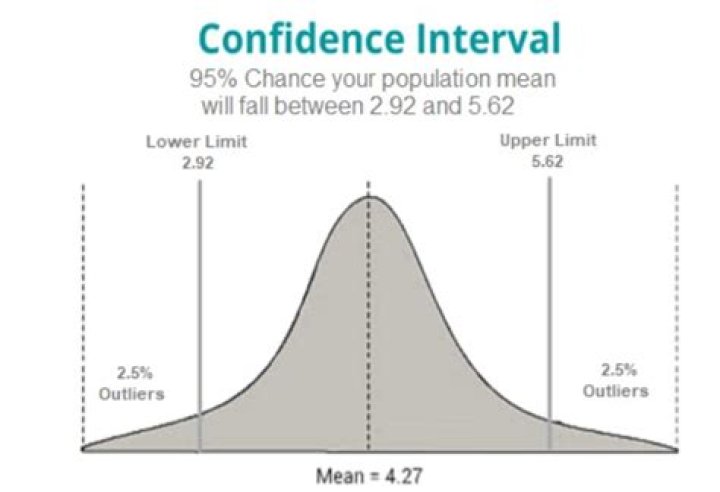
When we run studies we want to be confident in the results from our sample. Confidence intervals show us the likely range of values of our population mean. When we calculate the mean we just have one estimate of our metric; confidence intervals give us richer data and show the likely values of the true population mean.Why is a 99 confidence interval wider than a 95 confidence interval?
For example, a 99% confidence interval will be wider than a 95% confidence interval because to be more confident that the true population value falls within the interval we will need to allow more potential values within the interval. The confidence level most commonly adopted is 95%.Is a 90% confidence interval narrower than a 95% confidence interval?
A 99 percent confidence interval would be wider than a 95 percent confidence interval (for example, plus or minus 4.5 percent instead of 3.5 percent). A 90 percent confidence interval would be narrower (plus or minus 2.5 percent, for example).How do you compare confidence intervals?
To determine whether the difference between two means is statistically significant, analysts often compare the confidence intervals for those groups. If those intervals overlap, they conclude that the difference between groups is not statistically significant. If there is no overlap, the difference is significant.What is a good confidence level?
Providing a Range of Values You determine the level of confidence, but it is generally set at 90%, 95%, or 99%. Confidence intervals use the variability of your data to assess the precision or accuracy of your estimated statistics.How do you determine confidence level?
Find a confidence level for a data set by taking half of the size of the confidence interval, multiplying it by the square root of the sample size and then dividing by the sample standard deviation. Look up the resulting Z or t score in a table to find the level.What is a statistically significant sample size?
Generally, the rule of thumb is that the larger the sample size, the more statistically significant it is—meaning there's less of a chance that your results happened by coincidence.Why is a confidence interval important?
Importance of Confidence Intervals. Market research is about reducing risk. Confidence intervals are about risk. They consider the sample size and the potential variation in the population and give us an estimate of the range in which the real answer lies.Does sample size affect confidence interval?
Increasing the sample size decreases the width of confidence intervals, because it decreases the standard error. c) The statement, "the 95% confidence interval for the population mean is (350, 400)", is equivalent to the statement, "there is a 95% probability that the population mean is between 350 and 400".How do you determine a sample size?
How to Find a Sample Size Given a Confidence Interval and Width (unknown population standard deviation)- za/2: Divide the confidence interval by two, and look that area up in the z-table: .95 / 2 = 0.475.
- E (margin of error): Divide the given width by 2. 6% / 2.
- : use the given percentage. 41% = 0.41.
- : subtract. from 1.