What receives impulses and conducts them to the cell body?
.
Similarly, it is asked, what type of process conducts nerve impulses toward the cell body?
Typical neurons have several dendrites - branching processes that conduct impulses toward the cell body, and a single axon - a long straight process that conducts impulses away from the cell body. Axons are often referred to as nerve fibers.
Also Know, what is the branching filaments that conduct nerve impulses towards the cell? A typical neuron has a cell body containing a nucleus, one or more branching filaments called dendrites which conduct nerve impulses towards the cell body and one long fibre, an axon, that carries the impulses away from it.
Accordingly, how do motor impulses move throughout the body?
Muscles move on commands from the brain. When a motor neuron inside the spinal cord fires, an impulse goes out from it to the muscles on a long, very thin extension of that single cell called an axon. When the impulse travels down the axon to the muscle, a chemical is released at its ending.
What transmits impulses within the brain and spinal cord?
Motor neurons carry impulses from the brain and spinal cord to muscles or glands.
Related Question AnswersWhat is a group of axons called?
In the peripheral nervous system a bundle of axons is called a nerve. In the central nervous system a bundle of axons is called a tract. Each axon is surrounded by a delicate endoneurium layer. The course connective tissue layer called perineurium, binds the fibers into bundles called fascicles.Which part conducts signals away from the cell body?
While variable in size and shape, all neurons have three parts. Dendrites receive information from another cell and transmit the message to the cell body. The cell body contains the nucleus, mitochondria and other organelles typical of eukaryotic cells. The axon conducts messages away from the cell body.How is nerve impulse conducted?
Summary. Neurons, or nerve cells that carry nerve impulses, are made up of the cell body, the axon, and several dendrites. Signals move across the synapse, the place where the axon of one neuron meets the dendrite of another, using chemicals called neurotransmitters.How can an impulse be stopped?
If instead the neuron gets as many inhibitory as excitatory impulses, the inhibition cancels out the excitation and the nerve impulse will stop there. Action potential generation is proportionate to the probability and pattern of neurotransmitter release, and to postsynaptic receptor sensitization.Why are nerve impulses important?
The membrane potential is the basis for the conduction of nerve impulses along the cell membranes of neurons. Ions that are important in the formation of a nerve impulse include sodium (Na+) and potassium (K+). Ion channels and ion pumps are very specific; they allow only certain ions through the cell membrane.What are the two main divisions of the nervous system?
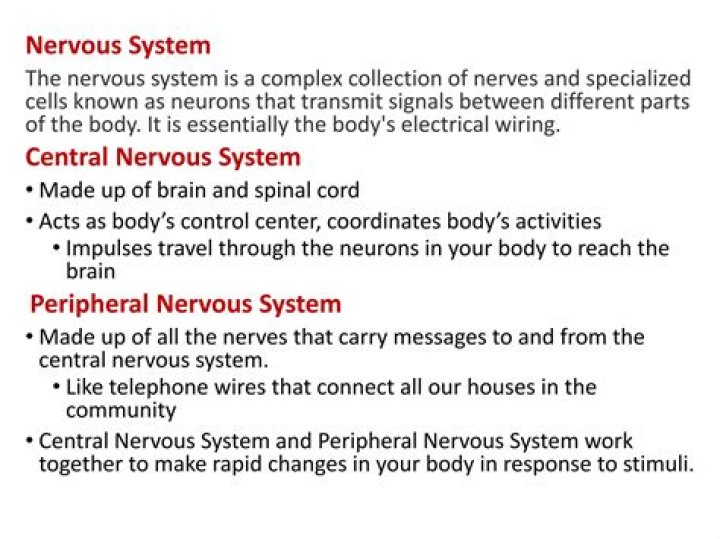
Structural Divisions of the Nervous System. The nervous system can be divided into two major regions: the central and peripheral nervous systems. The central nervous system (CNS) is the brain and spinal cord, and the peripheral nervous system (PNS) is everything else (Figure 8.2).What is the purpose of neurons?
Neurons (also known as neurones, nerve cells and nerve fibers) are electrically excitable cells in the nervous system that function to process and transmit information. In vertebrate animals, neurons are the core components of the brain, spinal cord and peripheral nerves.What do dendrites do?
Function of Dendrites In order for neurons to become active, they must receive action potentials or other stimuli. Dendrites are the structures on the neuron that receive electrical messages. These signals will accumulate in the cell body, or soma, of the neuron after being received by the dendrites.How do we move our body?
The brain sends signals via the nervous system, including the spinal cord and nerves, to the muscles. The muscles then contract to create movement. Your muscles work in conjunction with tendons and joints, which help your muscles move your skeletal bones to accomplish movement.How does the nervous system work with other systems?
Your nervous system interacts with every other system in your body. Your endocrine system works closely with your brain and central nervous system to control the creation of specific hormones and enzymes. Your digestive and excretory systems work with the nervous system in both conscious and unconscious ways.How does the brain send and receive messages?
The average human brain contains about 86 billion nerve cells, called neurons. These are the building blocks of your brain. Neurons communicate with each other by sending chemical and electrical signals. Impulses rush along tiny fibres, like electrical wires, from one neuron to the next.How does your body respond to stimuli?
A stimuli is an environmental cue from either the internal environment or the external environment The stimuli is detected by receptors, which pass a signal along to the brain or spinal column through sensory neurones. The brain and spinal column make up the CNS, and they coordinate the body's response to the stimuli.How does your brain communicate with the rest of your body?
The central nervous system communicates with the rest of the body by sending messages from the brain through the nerves that branch off of your spine. The chemical and electrical impulses, through contractions of your skeletal muscles, result in the movement of your body.How does the brain and body work together?
The two halves of the nervous system work together in order for your body to properly communicate its sensations and needs. The brain sends messages via the spinal cord to peripheral nerves throughout the body that serve to control the muscles and internal organs.What is the job of a synapse?
The function of the synapse is to transfer electric activity (information) from one cell to another. The transfer can be from nerve to nerve (neuro-neuro), or nerve to muscle (neuro-myo). The region between the pre- and postsynaptic membrane is very narrow, only 30-50 nm.What are the three types of neurons?
For the spinal cord though, we can say that there are three types of neurons: sensory, motor, and interneurons.- Sensory neurons.
- Motor neurons.
- Interneurons.
- Neurons in the brain.