Where are the saddle joints in the body?
.
Beside this, how many saddle joints are in the body?
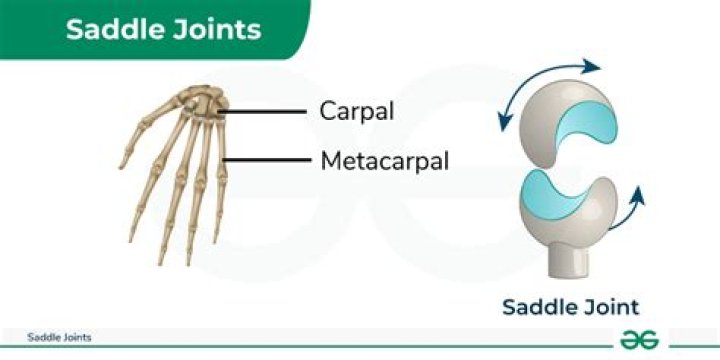
It is only found in two joints such as the carpal bone of thumb and tarsal bone of the foot.
Furthermore, what does a saddle joint look like? A saddle joint is a synovial joint where one of the bones forming the joint is shaped like a saddle with the other bone resting on it like a rider on a horse. The best example of a saddle joint in the body is the carpometacarpal joint of the thumb that is formed between the trapezium bone and the first metacarpal.
Just so, what part of the anatomy is the only saddle joint in your body?
Saddle joints are said to be biaxial, allowing movement in the sagittal and frontal planes. Examples of saddle joints in the human body include the carpometacarpal joint of the thumb, the sternoclavicular joint of the chest, and the incudomalleolar joint of the middle ear.
Is the thumb the only saddle joint?
The thumb is the only saddle joint in the human body.
Related Question AnswersWhat is the most flexible joint in the body?
The most flexible joint in the entire human body, our shoulder joint is formed by the union of the humerus, the scapula (or shoulder blade), and the clavicle (or collarbone). Commonly thought of as a single joint, the shoulder is actually made up of two separate joints - the glenohumeral and acromioclavicular joints.Is the ankle a pivot joint?
The intervertebral joints are this type, and many of the small bones of the wrist and ankle also meet in gliding joints. The jaw is primarily a hinge joint but it can also move somewhat from side to side. The knee and ankle joints are hinge joints that also allow some rotary movement.What is a gliding joint example?
Gliding joints allow the bones to glide past one another in any direction along the plane of the joint - up and down, left and right, and diagonally. An example of the gliding joint is zygapophyses of adjacent vertebrae. So, the correct answer is 'Zygapophyses of adjacent vertebrae'.What is meant by saddle joint?
Medical Definition of saddle joint : a joint (as the carpometacarpal joint of the thumb) with saddle-shaped articular surfaces that are convex in one direction and concave in another and that permit movements in all directions except axial rotation.What is an example of a Condyloid joint?
The oval-shaped condyle of one bone fits into the elliptical cavity of the other bone. These joints allow biaxial movements—i.e., forward and backward, or from side to side, but not rotation. Radiocarpal joint and Metacarpo-phalangeal joint are examples of condyloid joints.Where is a Condyloid joint found?
condylar joint (condyloid joint) one in which an ovoid head of one bone moves in an elliptical cavity of another, permitting all movements except axial rotation; this type is found at the wrist, connecting the radius and carpal bones, and at the base of the index finger.What is a synovial joint?
A synovial joint, also known as diarthrosis, joins bones with a fibrous joint capsule that is continuous with the periosteum of the joined bones, constitutes the outer boundary of a synovial cavity, and surrounds the bones' articulating surfaces. The synovial cavity/joint is filled with synovial fluid.What is pivot joint?
In animal anatomy, a pivot joint (trochoid joint, rotary joint, lateral ginglymus) is a type of synovial joint. In pivot joints, the axis of a convex articular surface is parallel with the longitudinal axis of the bone.What is the best example of a gliding joint?
(1) Gliding joints move against each other on a single plane. Major gliding joints include the intervertebral joints and the bones of the wrists and ankles. (2) Hinge joints move on just one axis. These joints allow for flexion and extension.Is the spine a pivot joint?
Pivot joints are joints that allow bones to rotate. In a pivot joint, a cylinder shaped bone rotates inside another bone or ligament that forms a ring around it. In your neck, there's a pivot joint between your skull and the top vertebrae that allows your head to turn.How many joints are in the human body?
Answer and Explanation: There are 360 joints in the human body. A joint is the point of attachment of two bones.How gliding joints are important to us?
Gliding joints- It is a common type of synovial joint formed between bones or nearly flat articular surfaces. It allows the bones to glide past one another in any direction along the plane of the joint. For example- Our ankles, and wrists move and work by gliding against each other.What are the 3 major types of joints?
There are three main types of joints; Fibrous (immovable), Cartilaginous (partially moveable) and the Synovial (freely moveable) joint.Where are my joints located?
Joints are formed where bones come together. The six types of synovial joints are the pivot, hinge, saddle, plane, condyloid, and ball-and-socket joints. Pivot joints are found in your neck vertebrae, while hinge joints are located in your elbows, fingers, and knees. Saddle and plane joints are found in your hands.Is the spine a saddle joint?
Joints are the place where two bones meet. The bones in your skull are held together with fibrous connective tissue. Slightly movable joints. Other joints, such as those between the vertebrae in your spine, which are connected to each other by pads of cartilage, can only move a small amount.What are the functions of joints?
Joints are functional junctions between two or more bones. Joints bind the skeleton together, to give structure and allow muscles to move bones to perform certain tasks such as running, reaching and grasping.Is the thumb a ball and socket joint?
An example of this type of joint is the thumb joint. Condyloid joints: These joints are biaxial. An example of this type of joint is the knuckle. Ball and socket joints: Ball and socket joints consist of spherical head articulating with a dome shaped cup.What kind of joints are in the fingers?
Interphalangeal joints: These hinge joints allow flexion and extension. They join the heads of the phalanges with the bases of the next distal phalanges. Each finger (digits two through five) has one proximal interphalangeal joint and one distal interphalangeal joint. The thumb has only one interphalangeal joint.What are the different kinds of joints?
Planar, hinge, pivot, condyloid, saddle, and ball-and-socket are all types of synovial joints.- Planar Joints. Planar joints have bones with articulating surfaces that are flat or slightly curved faces.
- Hinge Joints.
- Condyloid Joints.
- Saddle Joints.
- Ball-and-Socket Joints.