The upper and lower surfaces of the rings are hydrophobic, while the edges are hydrophilic. At the same time, each nucleotide has two very hydrophilic groups: a negatively charged phosphate and a sugar (carbohydrate) group. Both form H-bonds and will interact strongly with water..
Similarly, are nucleic acids hydrophobic or hydrophilic?
Thus the covalent backbones of nucleic acids consist of alternating phosphate and pentose residues, and the characteristic bases may be regarded as side groups joined to the backbone at regular intervals. Also note that the backbones of both DNA and RNA are hydrophilic.
is adenine hydrophilic or hydrophobic? Adenine is a large, more-hydrophobic base with a smaller number of hydrogen bonding partners than other bases, while cytosine is a smaller, less-hydrophobic base with a greater number of hydrogen bonding partners than other bases.
Considering this, are nucleotide bases hydrophobic?
DNA is constructed of two strands, consisting of sugar molecules and phosphate groups. The environment is therefore hydrophilic, while the DNA molecules' nitrogen bases are hydrophobic, pushing away the surrounding water.
Do nucleotides dissolve in water?
Single nucleotides are readily soluble in water. When you polymerise them they are still soluble, but they produce gels at some point.
Related Question Answers
Is DNA hydrophilic or hydrophobic?
The environment is therefore hydrophilic, while the DNA molecules' nitrogen bases are hydrophobic, pushing away the surrounding water. When hydrophobic units are in a hydrophilic environment, they group together, to minimise their exposure to the water.Is DNA a protein?
No DNA is not protein. Proteins are made of amino acids whereas DNA is made of nucleotide bases.. DNA Carries the genetic instructions and genes are basically DNA sequence that instruct to produce specific proteins.. the flow of info is like DNA to mRNto proteins, this is also called central dogma..Are carbohydrates hydrophilic or hydrophobic?
Carbohydrates are Hydrophilic. They have large amounts of oxygen and therefore, polar molecules, according to “Carbohydrates (1)”.Is protein hydrophobic or hydrophilic?
Hydrophobic and Hydrophilic The interior and the exterior of cells is liquid, usually a solution or suspension of ions, small molecules and large molecules dissolved in water. Proteins must therefore be hydrophilic ("water loving") in order to be suspended in this environment.What is DNA made of?
DNA is made up of molecules called nucleotides. Each nucleotide contains a phosphate group, a sugar group and a nitrogen base. The four types of nitrogen bases are adenine (A), thymine (T), guanine (G) and cytosine (C). The order of these bases is what determines DNA's instructions, or genetic code.Is water a lipid?
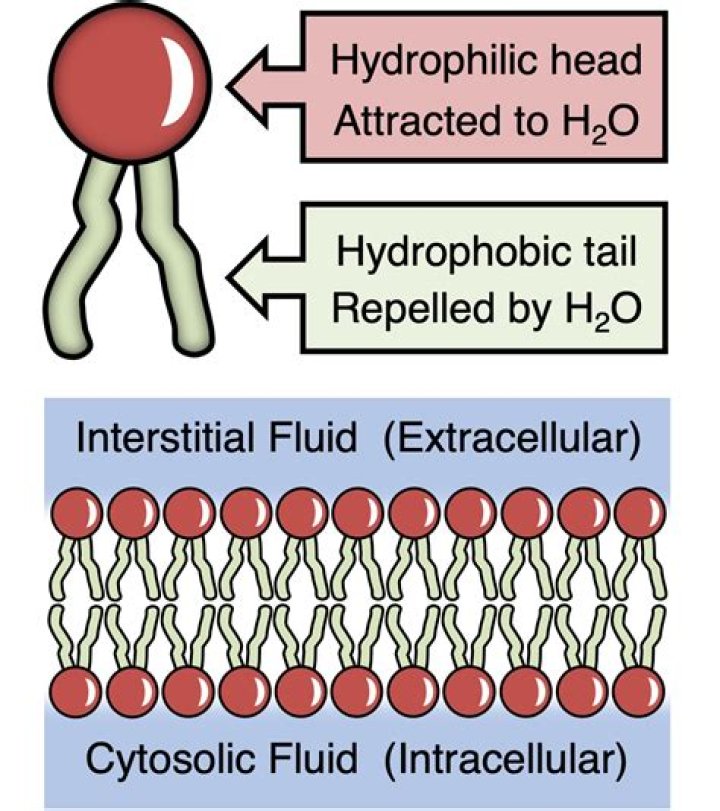
Although the molecule as a whole is water-insoluble by virtue of its hydrophobic hydrocarbon chain, the negatively charged carboxylate is hydrophilic. This common form for biological lipids—one that contains well-separated hydrophobic and hydrophilic parts—is called amphipathic.Are cells made of proteins?
Cells are partly made of proteins. Proteins are mostly made up of amino acids. Amino acids are made of Carbon, Oxygen, Nitrogen, Hydrogen, and Sulfur. These 5 elements are made of protons, neutrons, and electrons.What is full form of RNA?
RNA: Ribonucleic Acid RNA stands for Ribonucleic Acid. It is one of the major biological macromolecules that is essential for all known forms of life. It performs various important biological roles related to protein synthesis such as transcription, decoding, regulation and expression of genes.Is DNA soluble in water?
DNA is polar due to its highly charged phosphate backbone. Its polarity makes it water-soluble (water is polar) according to the principle "like dissolves like". At an atomic level, the reduction in the force acting on a charge results from water molecules forming a hydration shell around it.Is DNA negatively charged?
DNA has a negative charge due to the negative charge of its phosphate component. The other two components of DNA consist of a 5-carbon sugar and a nitrogen base. The phosphate are found in the ribose-phosphate backbone of DNA.Who discovered DNA?
James Watson
Is ATP a nucleotide?
ATP is a nucleotide consisting of an adenine base attached to a ribose sugar, which is attached to three phosphate groups. When one phosphate group is removed by breaking a phosphoanhydride bond in a process called hydrolysis, energy is released, and ATP is converted to adenosine diphosphate (ADP).Where Is DNA Found?
Nearly every cell in a person's body has the same DNA. Most DNA is located in the cell nucleus (where it is called nuclear DNA), but a small amount of DNA can also be found in the mitochondria (where it is called mitochondrial DNA or mtDNA).What is hydrophobic in science?
To be hydrophobic means to fear water. In chemistry, it refers to the property of a substance to repel water. Hydrophobic molecules tend to be nonpolar molecules that group together to form micelles rather than be exposed to water. Hydrophobic molecules typically dissolve in nonpolar solvents (e.g., organic solvents).Are bases hydrophobic?
The environment is therefore hydrophilic, while the DNA molecules' nitrogen bases are hydrophobic, pushing away the surrounding water. When hydrophobic units are in a hydrophilic environment, they group together, to minimise their exposure to the water.Who discovered nitrogenous bases?
During the 1920s, biochemist P.A. Levene analyzed the components of the DNA molecule. He found it contained four nitrogenous bases: cytosine, thymine, adenine, and guanine; deoxyribose sugar; and a phosphate group.Why is DNA hydrophilic in nature?
The phosphate groups on DNA are ionic and charged. Each phosphate group on the DNA backbone is one unit of negative charge (-1). Charged molecules attract water and are hydrophilic. DNA has two hydrophilic polar external backbones made of sugars and phosphate groups joined by ester bonds.Is DNA polar or nonpolar?
The sugar-phosphate backbone of DNA is polar, and therefore hydrophillic; thus it likes to be proximal to water. The interior portion of DNA, the bases, are relatively non-polar and therefore hydrophobic.What is hydrophobic water?
In chemistry, hydrophobicity is the physical property of a molecule (known as a hydrophobe) that is seemingly repelled from a mass of water. Because water molecules are polar, hydrophobes do not dissolve well among them. Hydrophobic molecules in water often cluster together, forming micelles.