Is wrist broken or sprained?
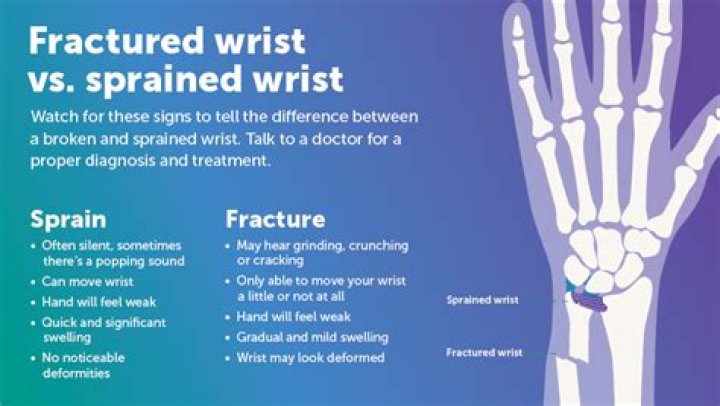
.
Also, how can I tell if I broke my wrist or just sprained it?
Signs of a Fracture vs. a Sprain
- Swelling in the wrist.
- Bruising over the wrist or surrounding area.
- Pain when moving the wrist or hand.
- Weakness or inability to grasp or pick up objects.
Also, how long does a sprained wrist take to heal? Wrist sprains usually take from 2 to 10 weeks to heal, but some take longer. Usually, the more pain you have, the more severe your wrist sprain is and the longer it will take to heal. You can heal faster and regain strength in your wrist with good home treatment.
Additionally, can you move your wrist if it's fractured?
When the wrist is broken, there is pain and swelling. It can be hard to move or use the hand and wrist. Some people can still move or use the hand or wrist even if there is a broken bone. There is often pain right around the break and with finger movement.
How do you tell if a child's wrist is broken or sprained?
- Swelling and tenderness.
- Pain and stiffness.
- Bruising or changes in skin color.
- Popping sound in your child's wrist when he or she moves it.
What does a broken wrist feel like?
A broken wrist might cause these signs and symptoms: Severe pain that might worsen when gripping or squeezing or moving your hand or wrist. Swelling. Tenderness.What is a hairline fracture in the wrist?
A hairline fracture, also known as a stress fracture, is a small crack or severe bruise within a bone. People with osteoporosis can also develop hairline fractures. Hairline fractures are often caused by overuse or repetitive actions when microscopic damage is done to the bone over time.How can I tell if I have a hairline fracture in my wrist?
The most common symptom of a hairline fracture is pain. This pain can gradually get worse over time, especially if you don't stop weight-bearing activity. Pain is usually worse during activity and lessens during rest.What are the symptoms of a hairline fracture?
- swelling.
- tenderness.
- bruising.
Do you get a cast for a hairline fracture in your wrist?
Hairline fractures usually heal by themselves but usually require immobilization. Immobilzation of the wrist can hold the bones and joints in position to allow the hairline fracture to heal faster and limit pain during the healing process. Immobilization may require a custom splint or a cast.Do you need a cast for a sprained wrist?
Elevate the injury by keeping the joint above the level of the heart. Grade two sprains may need to be immobilized with a wrist brace, splint or cast for a few weeks. This immobilization may cause some stiffness in the wrist; therefore, stretching exercises may be used to help regain full mobility and function.When should you see a doctor for a sprained wrist?
When To Call a Professional For milder sprains, call your doctor if your wrist symptoms do not improve within two to three days after your injury.Can you have a broken wrist without swelling?
Sometimes a bone can break without you realizing it. Many people with a fractured scaphoid think they have a sprained wrist instead of a broken bone because there is no obvious deformity and very little swelling.How do you wrap a sprained wrist?
How to wrap a sprained wrist- Wrap the bandage around your wrist once, starting at the pinky side of your hand and with your hand facing down.
- Pull the bandage to your thumb side and wrap around your palm once.
- Cross the bandage back down to your wrist and wrap again around the wrist.
Can you move your fingers with a broken wrist?
When the wrist is broken, there is pain and swelling. Some people can still move or use the hand or wrist even if there is a broken bone. Swelling or a bone out of place can make the wrist appear deformed. There is often pain right around the break and with finger movement.What should you not do with a sprained wrist?
What's the Treatment for a Wrist Sprain?- Rest your wrist for at least 48 hours.
- Ice your wrist to reduce pain and swelling.
- Compress the wrist with a bandage.
- Elevate your wrist above your heart, on a pillow or the back of a chair.
- Take anti-inflammatory painkillers.
- Use a cast or splint to keep your wrist immobile.
Should you wrap a sprained wrist overnight?
However, if you are experiencing a great deal of pain, and get some relief from keeping your ankle wrapped at night, an elastic bandage should help. Some sources say it's OK to stay wrapped at night, but be sure that the bandage is very loose.Will a sprained wrist heal on its own?
Most of the time, a sprained wrist will heal on its own. There are a few ways to alleviate the pain of a wrist sprain and speed the healing process. Rest your wrist for a couple of days, icing it for 20-30 minutes every few hours. Severe wrist sprains often require surgery to repair the snapped ligament.How long should I wear a wrist brace for a sprain?
Wrist taping and/or Bracing Keeping the wrist from moving (immobilization) is often needed for more severe wrist sprains, and may be recommended for 1-2 weeks to let the ligaments heal; the Aircast A2 Wrist Brace and Quick Fit Wrist are for this purpose and may be prescribed.Is a sprained wrist serious?
Wrist sprains can be mild to severe. They are ranked by how severely the ligament is pulled or torn away from the bone. Grade 1 -- Ligaments are stretched too far, but not torn. This is a mild injury.Can a sprained wrist get worse?
Usually in that case, if the pain subsides over the next few days, it's typically considered a wrist fracture. But if the pain is not getting better and persists and the swelling gets worse, difficult use to the hand, etc., many times an X-ray is warranted to determine if it is a wrist fracture or not.Can a sprain turn into a fracture?
A sprain is classified as a stretched or torn ligament or tendon, while a fracture is a broken bone. If you're experiencing pain around the soft tissue but not over your bone, it's likely that you have a sprain and not a break.What is wrist injury?
Wrist Injury Causes The most common cause of wrist injuries is a fall on an outstretched hand. You can also have wrist pain from repetitive use that results in an inflammation of the tendons (tendonitis). Carpal tunnel syndrome is another common wrist injury that may occur from repetitive motion.How do you tell if you have a dislocated wrist?
The main symptom of a dislocated wrist is intense pain that's usually worse when you try to move your wrist up and down or side to side. You might also feel pain in your forearm.You may also notice the following around your wrist:
- swelling.
- tenderness.
- weakness.
- discoloration or bruising.